Your resume has about six seconds to make an impression. That’s not a metaphor; it’s the average time a recruiter spends during a first scan of a resume before deciding whether to keep reading or move on.
You have just six seconds to communicate what you offer and why you’re the right fit for the role.
In a job market that has never been more competitive or more scrutinized, most candidates are still submitting resumes built on outdated advice like objective statements that serve no one, generic summaries loaded with buzzwords, and formatting that confuses the humans and technology used to sort through them. The result? Qualified candidates get passed over not because of what they’ve accomplished, but because of how, or how poorly, they presented it.
A modern resume isn’t just an updated list of your work history. It’s a strategic marketing document, one that speaks directly to a specific employer’s needs, leads with proof, and earns a second look in those crucial first seconds. Whether you’re actively job hunting, passively open to opportunities, or simply overdue for a professional refresh, this guide will walk you through everything a resume needs to work hard for you in today’s market.
Basic Information
The basic information section is critical because it provides all the necessary details for an employer to identify you and initiate contact. Your resume should include your name, city, state, phone number, email address and LinkedIn profile URL. Be sure to include at least your name and contact information on page 2.
A Targeted, Branded Headline and Summary
Your resume should begin with a tailored, value-driven headline that speaks directly to the job you want, rather than just the job you currently have. Instead of a generic summary padded with overused fluff like “results-driven” or “dynamic,” replace the heading with a branded title that mimics the target position. Beneath this, your summary should immediately grab the reader’s attention by highlighting your greatest strengths, indicating the level of responsibility you can handle, and incorporating relevant terminology from the job description.
Why it matters:
A resume is a personal marketing document written for the employer, not an autobiography written for you. Recruiters are overwhelmed and scan quickly to answer the question, “What can you do for me?” A headline that aligns with the job title being targeted. It can be branded with unique skills or qualifications, or a value proposition. And if additional qualifications exist, then including a concise summary makes it immediately clear that you are a qualified fit for their specific role.
Customized, Relevant Professional Experience
Your experience section should focus heavily on the most recent 10 to 15 years of your career history, ordered coherently with your job title, employer, and dates listed clearly. You must tailor this content for every single job application, adjusting the details to align with what the company currently needs. Rather than simply listing your past duties, position your experience to highlight the specific processes and levels of responsibility you managed.
Why it matters: In a highly saturated market, generic resumes rarely generate interviews, whereas customized resumes are three times more likely to secure one. By researching the employer’s pain points and positioning your experience as the exact solution they need, you differentiate yourself from competitors.
Accomplishment Bullets Backed by Proof and Metrics
Under your professional experience, replace vague claims like “excellent team player” with bullet points that document solid accomplishments. You should lead with results, front-loading the most impactful outcomes so they are immediately clear to the reader. The strongest resumes quantify success using metrics and numbers to provide context and scale.
Why it matters: Hiring managers want proof, not platitudes. Sharing specific metrics (e.g., “Reduced operating costs by 18%”) proves how well you performed your tasks and reinforces your credibility, making your application highly memorable.
Targeted Education, Technology, and Professional Development
Your resume should feature an education section that starts with your highest level of academic certification and works backward, including any graduation dates from the last five years. Additionally, you should list relevant non-academic training, community activities, and up-to-date technological skills that are widely used in your target industry.
Why it matters: These sections provide concrete evidence that you possess the necessary educational background, tools, and training required for the role. Showcasing memberships or certifications also projects a professional impression and proves you are actively invested in your career development.
Strategic Presentation and Authentic Storytelling
The overall format and presentation of your resume are vital, particularly the top third of the file, which is the most critical real estate. You should incorporate an active voice, weave in appropriate keywords, and use plenty of white space to make the document highly readable. Furthermore, there is no absolute rule for length; let your relevant content dictate how long the resume needs to be, ensuring you cut out any irrelevant filler. Keep the tone authentic to your personal leadership style and brand.
Why it matters: Even the best content will be overlooked if it is difficult to read. Clean formatting allows your top achievements to shine immediately. Furthermore, modern employers are hiring for cultural fit as much as capability; an authentic resume builds trust and attracts companies that align with your unique values.
Simple and Intuitive Formatting
To maximize your chances of getting noticed, your resume must utilize a simple, straightforward format that prioritizes readability. Use appropriate white space to make the text easy on the eyes, and remember that while content is king, a clean presentation is equally essential. Instead of complex or convoluted designs, strive for a simple, single-column structure that immediately communicates your goals. For example, drop the generic “Summary” heading in favor of a clear, branded title that mirrors the position you are applying for. Follow this with a short paragraph outlining your value and a list of bulleted keywords to punctuate your qualifications. You must also assume that your resume might get separated from your cover letter, so the format needs to allow the document to clearly and simply stand on its own.
Why it matters: Being highly qualified is simply not enough; if your resume isn’t easy to read, it won’t get reviewed. Recruiters are incredibly overwhelmed with applications and do not have the time to hunt through dense text for hidden nuggets of information. A simple format ensures that a hiring manager knows exactly what role you want and what value you bring to the table the moment they glance at your document
OTHER CONSIDERATIONS
Here are some additional topics worth considering for your blog post:
ATS Optimization
Applicant Tracking Systems are like digital filing cabinets. They simply store your information. However, it’s important that the information is categorized correctly. To do this, use a simple resume format and avoid tables, text boxes, headers/footers, images, and unusual fonts. There are over 200 different ATS systems and they all have unique features, however, these guidelines are fairly universal. Using the skills and terminology throughout the resume that are requested in the job posting will help recruiters searching for those terms discover your resume.
File Format Guidance
PDF vs. Word (.docx) is a genuinely confusing decision for most job seekers. Some ATS systems parse Word docs better; some employers prefer PDFs for formatting consistency. The best advice is to follow the instructions provided by the employer.
The “Skills” Section
A standalone skills or core competencies section is increasingly common and strategically useful. This section can be a great place to front-load keywords without disrupting the narrative flow of the experience section.
Handling Employment Gaps or Non-Traditional Paths
Career changers, returners, and people with gaps face unique challenges. The good news is that the resume can be modified and adapted to accommodate these situation. Whether you use a hybrid of chronological and functional resume, and how you account for the time during a gap in employment is nuanced and based on each unique situation.
What to Leave Out
Modern resumes in the United States do not include headshots nor do they include the phrase “references available upon request. ” Age-revealing graduation dates and outdated formats like the objective statement are also no longer a must-have on a resume. .
LinkedIn Alignment
The information you supply in your resume should be similar to the information in your LInkedIn profile. Since LinkedIn is an online tool, it is often a better strategy to include more details and information that you might have space for on a resume. The other major difference is that your profile should use personal pronouns and reflect your brand.
The “One-Page Rule” Myth
There are some instances where a resume just needs to be two pages. If you have over 5 years of work experience or a significant amount of related experience, it is absolutely alright for a resume to include this and expand to two pages.
Bottom Line
Your resume is rarely the final word on your qualifications, but it is almost always the first. It’s what gets you in the room, onto the shortlist, and into the conversation where you can truly shine. A resume that’s clear, targeted, and honest about the value you bring won’t just survive an ATS scan or a six-second skim. It will make a hiring manager stop, and think: this is exactly who we need.
The good news is that none of this requires you to exaggerate, reinvent yourself, or hire a professional, though a second set of eyes never hurts. It requires honesty about your strengths, research into what employers actually need, and the discipline to tell your story in a way that serves the reader, not just yourself.
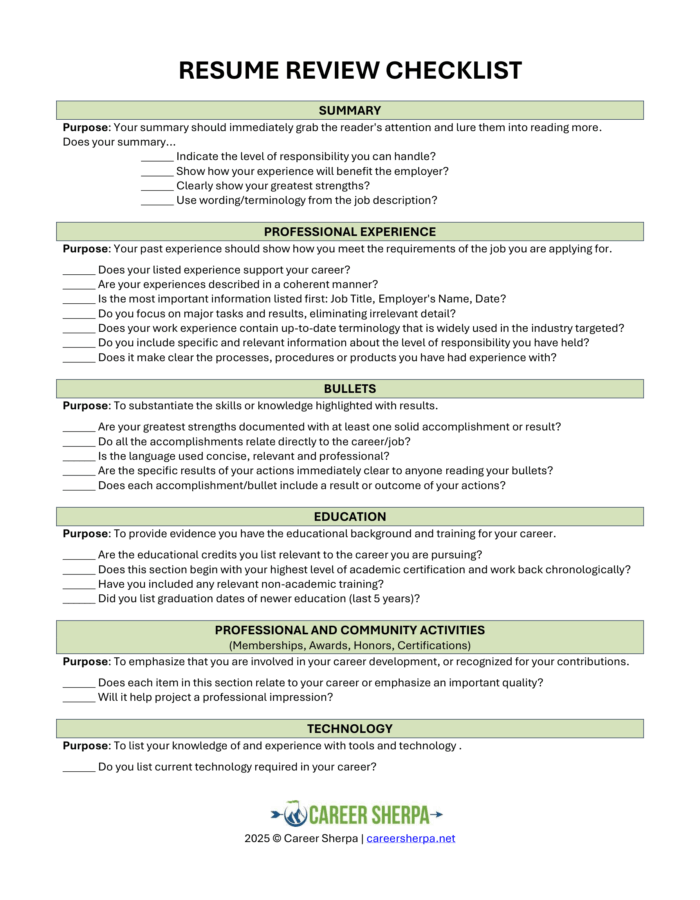
Use the checklist below as your starting point. Revisit your resume not as a record of your past, but as a pitch for your future. Because somewhere out there is a job worth applying for, and the version of you on paper should be every bit as compelling as the one who shows up to the interview.
CHECKLIST
Here’s a checklist to help you achieve a modern resume.