By the time a buyer books the meeting your team has been chasing, an AI chatbot has already created a shortlist, and helped the software buyer set price expectations and quietly pick a frontrunner.
AI search is changing the sales pipeline by moving the decision earlier, compressing weeks of buyer research into chatbot answers. The AI’s answer now decides who makes the shortlist, and that shortlist decides who gets a shot at the deal. Your pipeline is being shaped before a single lead reaches your team.
Most leaders hear “AI is changing how buyers research” and file it under marketing. That is the mistake. When the answer forms without you, the deal forms without you, and no amount of selling reaches a buyer who never had you on the list. This is a sales problem, and it is the one we are here to solve.
We have spent three earlier pieces exploring this shift: how AI forms the buyer’s first impression, how your best buyers disqualify you without a word, and how deals get shaped before your reps enter the room. Now, we’re covering how you can adapt to this shift and what the best revenue teams are doing about it.
TL;DR
- AI search has moved into the earliest, most decisive part of the buyer journey. Buyers now form a shortlist and a favorite inside a chatbot before your sales team ever gets involved.
- This shows up in your pipeline, which is why marketing-only fixes miss it. When your brand is absent from the AI answer, deals form without you and never surface as losses.
- The evidence AI leans on is written by the buying committee itself. It stays current, and it exists in every sales category.
- The teams pulling ahead treat sales conversations as intelligence and peer proof as pipeline infrastructure. Winning the answer now decides who wins the deal.
Why is AI search a sales pipeline problem, not just a marketing one?
Your pipeline is being reshaped by a system that can promote a competitor you have never lost to, and can introduce a challenger you have never heard of, all before your team gets a single signal.
G2’s researchers call this the “third great compression of the buyer journey.” The Yellow Pages once compressed a market into a book. Google compressed it into a page of results. AI has now compressed it into a single answer, and your brand is either in that answer or invisible to the buyer.
A marketing problem is about how well-known you are: your brand, your traffic, your share of voice.
A pipeline problem is about how many real opportunities show up for sales to work. They usually move together, so it is easy to treat them as the same thing. AI search has pulled them apart.
Think about how a deal used to start. A buyer had a need, went looking, found a handful of options, and somewhere in that hunt, your marketing or your reps could reach them. There were dozens of moments where you could get into the conversation. That is the funnel most sales teams are still built around.
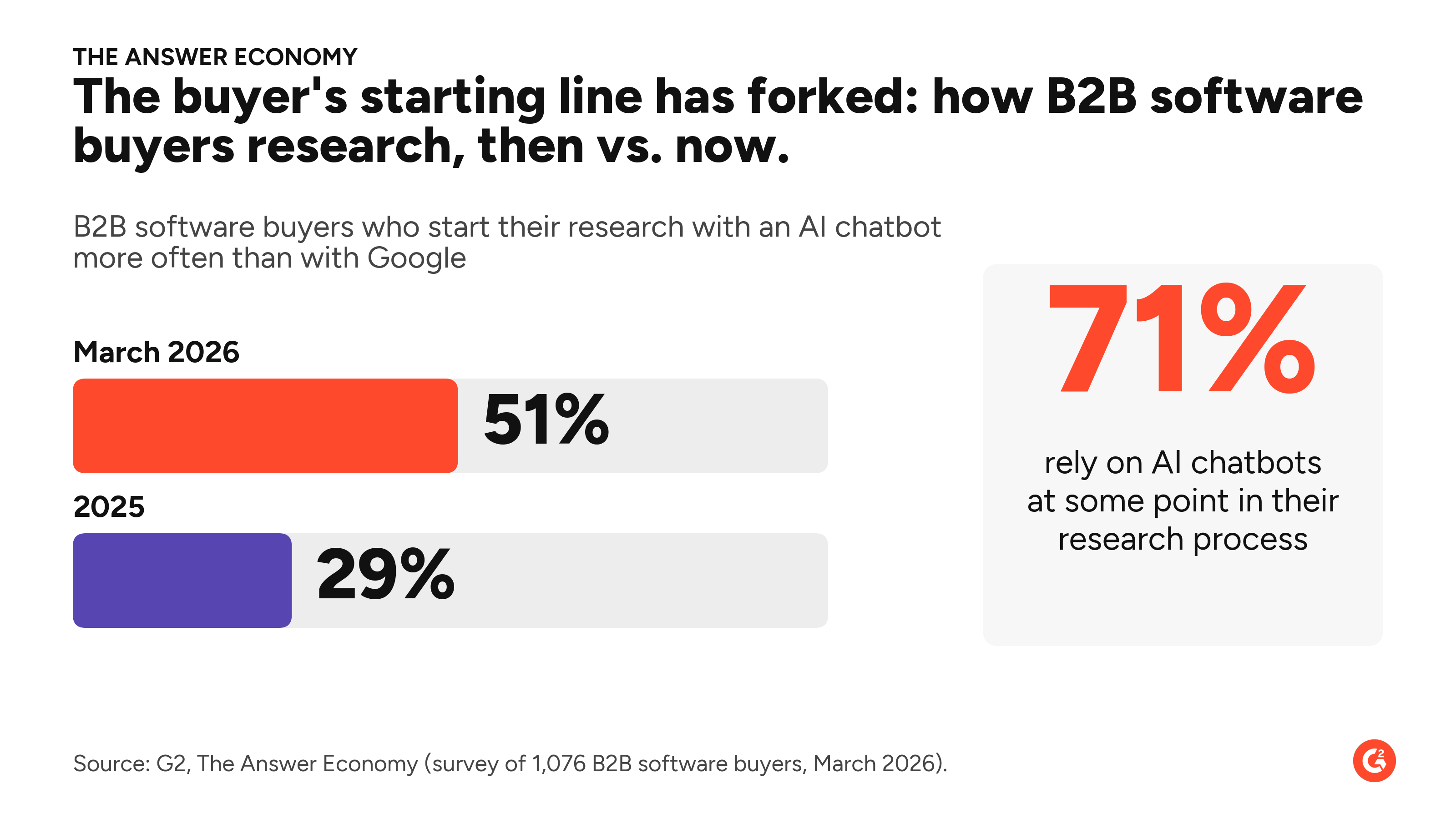
Now most of that hunt happens in one place, before you get a shot at any of it. The buyer opens ChatGPT or Gemini, describes what they need, and the AI returns a short list of vendors worth considering.
Here is why that lands on sales, not marketing. Whoever the AI names is who gets the meeting. Everyone else is invisible and never knows a deal was in play. So the AI is not just shaping your brand. It is choosing your pipeline, deciding which opportunities become real for your team, and which ones quietly go to someone else.
And once a buyer has that AI-built shortlist, it tends to stick. G2’s 2026 Buyer Behavior Report found that buyers who used an AI chatbot to build their shortlist went on to buy from it in at least three of their last five purchases 80% of the time, compared to 65% for buyers who did not.
Common root causes of pipeline decline in B2B sales
Most pipeline decline comes down to visibility. The team cannot see where the deal went, so they assume the fix is more effort. Here is the trap: On a dashboard, a visibility problem and an effort problem look identical, so teams pour in more activity and wonder why nothing moves.
Four causes show up repeatedly:
- You are absent from the AI answer: Deals lost this way leave no trace in your reports. They just look like a slow quarter, which is often a pipeline forming somewhere you cannot see, for someone else.
- Your social proof feels stale: Buyers and AI engines both judge you on recent, specific proof from real customers. When that proof stops refreshing, you fade from the material the machine assembles into answers. Standing still reads as risk to a buyer and as nothing at all to a model.
- You are misreading silence: An account with no opens, no replies, and no form fills is not necessarily inactive. It is often an account doing what most buyers now do: researching thoroughly and planning to surface only at the end. In a CRM, a quiet pipeline and a dead pipeline look identical. Teams keep treating the first like the second.
- Your measurement was built for the old journey: Marketing-qualified leads and sequence touches still fill a dashboard, but they were designed for a funnel that no longer exists. The board stays green while the shortlist forms in a chatbot. That is how a visibility problem gets mistreated as an effort problem.
Outbound still has a role, and good reps still matter. What changed is where the decision happens: it moved upstream, into a research phase built on AI answers and peer evidence.
Why is the traditional pipeline playbook no longer enough?
The old playbook rests on one assumption that quietly stopped being true: A seller can start the conversation.
Start with the win rates themselves. Outreach analyzed its own platform data for its 2025 sales report and found overall win rates trending down, with the largest group of teams now landing in the 21 to 25% bracket, down from 31 to 40% just a year earlier. Teams are working at least as hard as before, so effort hasn’t slipped. Timing has.
Opportunities that close within 50 days win at 47%. Those that drag past that threshold fall to 20% or lower. Speed roughly doubles your odds. But here is the trap for the old playbook: The clock that matters most starts before your team is even in the deal, during the long research phase you cannot see. By the time a buyer raises a hand, much of that window is already spent.
Outbound is still crucial, but the math has hardened. Outreach found that it now takes an average of five to seven touches to reach a contact for the first time. Human involvement still works, but it tends to land either too early, before a need exists, or too late, after the buyer’s verdict.
The old playbook was built to win the meeting. Trouble is, the meeting now works more like a closing argument than an opening one.
Where do buyers actually form their opinions before sales gets involved?
Most teams manage AI search and peer reviews as two separate channels, when they are really one machine showing two faces.
The chatbot builds the shortlist, and it builds it based on your customer feedback. G2’s own research makes the link explicit: Buyers name a citation from a review site as the single most confidence-inspiring signal they can see in an AI answer, ranking review sites as the number two influence on their shortlist, behind only the chatbots themselves. The AI builds the list. Your reviews decide who survives it.
There is a quieter layer beneath even that one.
Nate Nasralla, Founder of the buyer-enablement firm Fluint and author of Selling With, points out that the most decisive moments happen where no vendor is present at all. “Buying decisions are made during internal meetings, not sales meetings,” he notes, “when champions pitch their own team, in their own words.” The AI answer and the peer reviews are what your champion carries into that room. If the evidence is thin or off-message, your champion walks in unarmed.
How big is the peer evidence layer that AI reads from?
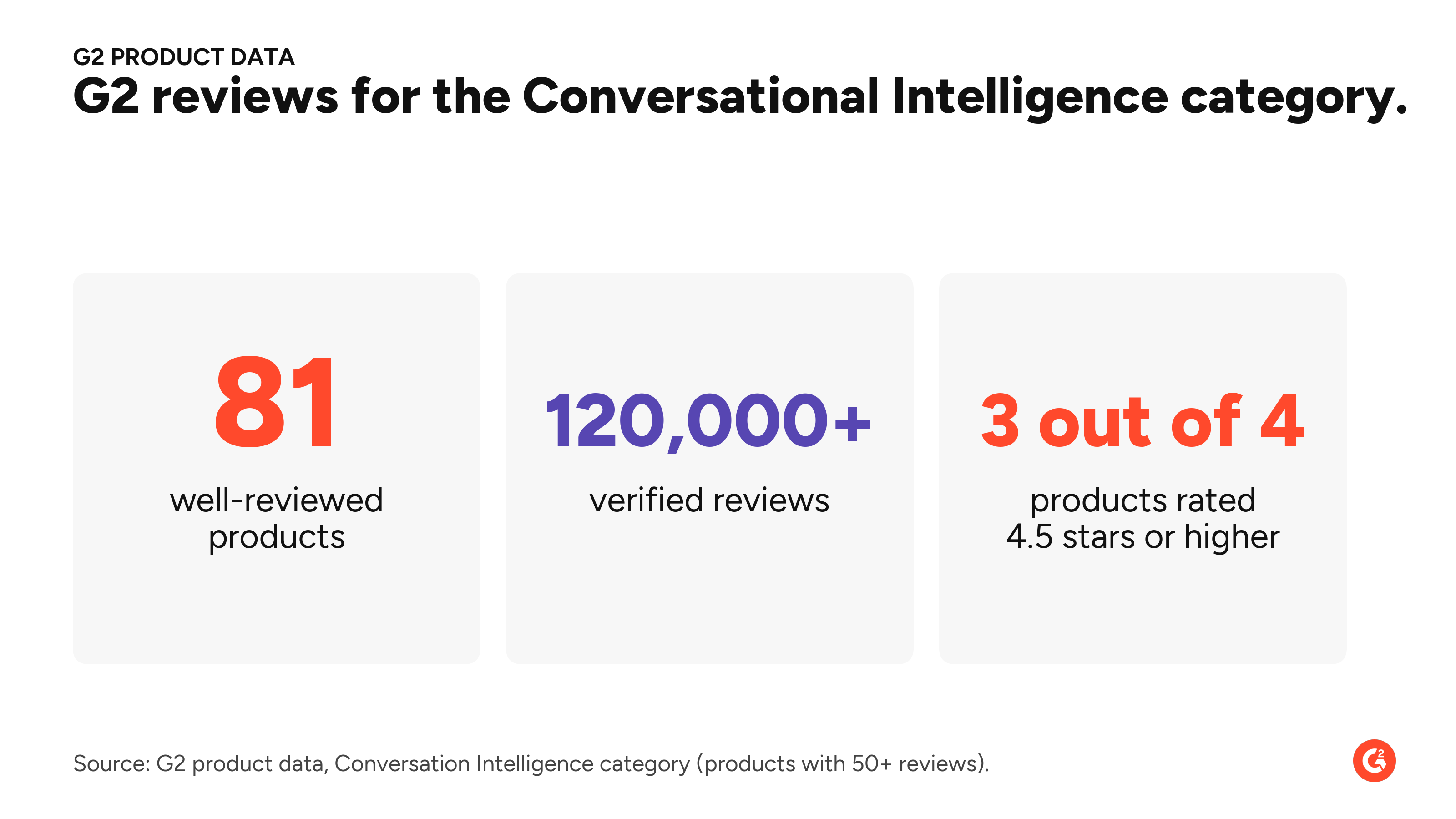
Take conversation intelligence, the category built specifically to turn sales conversations into insight. On G2, that single category includes 81 well-reviewed products with more than 120,000 verified reviews. Three out of four of those products are rated 4.5 stars or higher. This is a deep, active, credible body of evidence, and both buyers and AI engines read it.
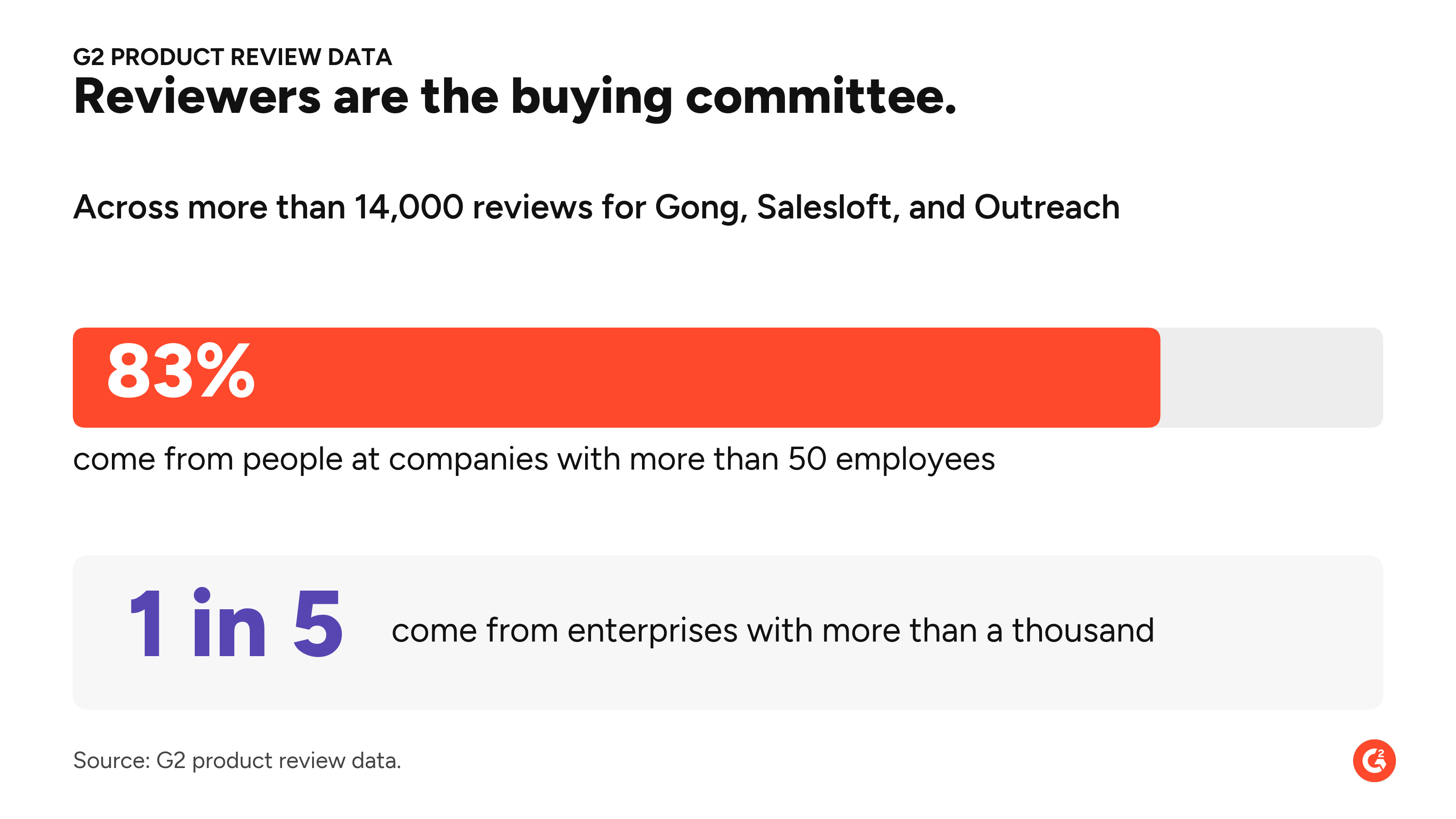
Look at the makeup of a category leader like Gong. Across more than 14,000 reviews for Gong, Salesloft, and Outreach, three of the most-reviewed platforms in the space, 83% come from people at companies with more than 50 employees, and one in five come from enterprises with more than a thousand.
The reviewer base runs deep into administrators, consultants, and executive sponsors, the exact people who implement this software and sit on the buying committee that approves it.
In other words, the “average” opinion an AI compresses into its answer comes from a room full of buyers who look a lot like your next deal. When a chatbot tells your prospect what a software is like, it is paraphrasing that average opinion.
The shelf also restocks constantly. Every day, fresh reviews land against the category leaders, which means the material both humans and machines judge you on is never static. And review sites are the only source besides AI chatbots that actually gain influence as buyers move deeper into the funnel, toward the moment money changes hands.
Think of your evidence as a position you hold, one you either defend or surrender quarter by quarter, rather than an asset you build once and bank. If your proof is fresh and specific, you keep showing up in the answer.
How do revenue teams use conversation data to improve win rates?
Revenue teams win by treating their own sales conversations as a source of intelligence and treating the peer evidence outside their walls as pipeline infrastructure. The best teams do both. And the payoff is now measurable at scale.
Gong analyzed 7.1 million sales opportunities across more than 3,600 companies for its 2026 State of Revenue AI report.
Teams that built AI into the core of how they sell generate 77% more revenue per rep than teams that treat it as optional.
Organizations that embed AI into their go-to-market (GTM) motion are 65% more likely to increase their win rates.
Seven in ten revenue leaders now say they trust the insights that come out of AI. Read those numbers carefully. The payoff lands in the win column, which is what makes this more than a story about reps saving a few hours a week.
Gong sells software, so treat its numbers as one input. But the pattern holds in independent research too. A controlled field experiment run by the Harvard Business School AI Institute and INSEAD, across 515 companies, found that firms that reorganized their work around AI were 18% more likely to win paying customers and generated 1.9 times the revenue of a control group with the same tools.
The researchers were blunt about what separated the two groups. It was not access to AI. Every firm had that. It was knowing where to point it, what they call the mapping problem.
For a revenue team, the highest-value place to point it in is the conversation data that tells you what buyers actually ask and what the market actually reads.
Gong Co-founder and Chief Executive Amit Bendov frames the shift carefully. “I don’t think people delegate decisions to AI, but they do rely on AI in the process of making decisions,” he told VentureBeat. “Humans are making the decision, but they’re largely assisted.” That is the useful mental model. The rep still makes the call. Conversation data just gives them better ammunition.
Here is how winning sales teams use that data strategically:
Mine calls for the questions AI is already answering: Every recorded discovery call is a transcript of what real buyers actually ask, worry about, and compare you against. That is the same ground an AI covers when a buyer prompts it. Teams that review conversation data systematically stop guessing at buyer objections and start seeing them in bulk, which tells them exactly which questions their public evidence needs to answer well.
Close the gap between what reps hear and what the market reads: When your reps know the top three reasons buyers pick you, but your reviews, comparisons, and profiles never state those things clearly, the AI has nothing confident to repeat. Winning teams route what the sales floor knows into the evidence the machine reads. The sales conversation and the AI answer stop contradicting each other.
Read the AI-built shortlist as competitive intelligence: When a buyer arrives already comparing you to two specific names, that shortlist is a live readout of how the market, and the model, group your category. It tells you who your real competitors are now, which may not be who they were last year.
Prioritize recency and specificity, because the machine does: A review that says “it replaced our old forecasting tool in six weeks” gives an AI something concrete to repeat. “Great product, highly recommend” gives it nothing. Teams pulling ahead coach their happiest customers to write recent, specific, problem-and-outcome reviews, because that is the raw material that earns a mention.
The through line is simple. Conversation data is the evidence AI turns into recommendations. Feed that layer deliberately, and you shape the answer your buyers see. Ignore it, and you let the market write your story.
What is the fastest way to rebuild pipeline after a significant drop?
Start by diagnosing correctly, because the fastest way to waste a quarter is to fix the wrong problem.
If pipeline fell, a common reaction is to add activity: more emails, more calls, more sequences. But if the real cause is that you disappeared from the AI answer, more activity cannot recover a deal that never became visible. You will burn effort interrupting buyers who already have a favorite.
So before you spend, run the check that actually matters. Type the prompts your buyers type. Ask ChatGPT, Gemini, and Perplexity for the best tool in your category, for your use case, at your price point. See who they name. See whether you are in the answer, described accurately, or missing entirely. The most proactive revenue teams have turned this into a standing practice: a quick weekly read on who the machine is recommending and who it forgot.
Then move on the levers that compound fastest. Get your external message consistent, because AI draws from a far wider surface than your website, and buyers treat agreement across chatbots as a trust signal.
Refresh your peer evidence where it has gone stale, prioritizing recent, specific reviews from real buyers over volume for its own sake. And make sure the answers your reps give on calls actually exist, in public, in the material the AI can find. Think of it as building your trust infrastructure. It is slower than sending another 500 emails, and it is the only thing that actually moves the answer. You cannot out-hustle an absence.
Be honest with yourself about the timeline: Trust does not rebuild in a week, so there is no overnight fix here. What you can get is a fast start, and it beats standing still. Every day you spend absent from the answer is a day competitors compound their evidence lead, and that lead is one that late movers spend years trying to close.
Why does this matter for the numbers you carry?
Because the decision moved to a place your pipeline reports cannot see, and the gap between teams that adapt and teams that wait compounds the same way reviews do: quietly, daily, and in someone else’s favor.
Sixty-nine percent of buyers chose a different vendor than they had first in mind because of what an AI told them, and one in three bought from a company they had never heard of before the chatbot named it. Layer on the timing math from earlier, the fact that deals closing inside 50 days win more than twice as often as slow ones, and the picture sharpens. The discovery call your rep is prepping for is often not a first meeting at all. It is a validation step for a choice that was mostly formed before your team entered the conversation.
The good news is that this is winnable with things you actually control. You cannot control everything an AI says about you. You can control the input: consistent positioning across every profile you own, fresh and specific peer evidence, and a sales motion that feeds the answer instead of fighting it. The vendors who invest in that trust layer are the ones the machine grows confident enough to recommend.
AI owns the first impression now. The outcome still belongs to revenue leaders who understand where their pipeline actually forms, and who show up there on purpose, with proof, before the answer is written.
Your buyers are already using AI to evaluate you. The only question is whether you are in the answer when they look. For the full playbook on winning the AI answer and rebuilding pipeline for the way buyers actually buy now, get our latest guide.
Frequently asked questions
Is AI search really replacing the traditional sales funnel?
It’s compressing the funnel rather than replacing it. The awareness, consideration, and shortlist stages that used to unfold over weeks and multiple touchpoints now often occur within a single AI conversation. Buyers still take sales calls, but usually later, and mostly to validate a choice they have already leaned toward. The funnel is still there. Its most decisive part has simply moved into a place sellers cannot see.
How do I know if my brand is missing from AI answers?
Test it directly. Type the questions your buyers ask into ChatGPT, Gemini, and Perplexity: the best tool in your category, for your kind of company, at your price. Note whether you appear, whether the description is accurate, and whether competitors show up instead. Do it regularly, because answers change as your evidence and your competitors’ evidence change. This simple habit is the cheapest early-warning system a revenue team has.
Can more sales activity fix a pipeline decline caused by AI search?
Usually not on its own. If the decline comes from being absent in the AI answer, more cold outreach cannot recover deals that were never visible to your team. Activity helps once you are in the consideration set, but it cannot manufacture consideration you lost upstream. The durable fix is to rebuild the evidence and positioning that gets you named in the answer, then let your sales motion work the buyers who surface.
Why do peer reviews matter so much to AI recommendations?
Because AI assistants build answers largely out of peer evidence, and they lean on it hardest at the bottom of the funnel, where deals are decided. Reviews are structured, specific, and written by real buyers, which makes them a trust signal a model can act on. A recommendation from a chatbot is, to a meaningful degree, a compression of what your customers wrote. Thin or stale evidence gives the machine little to be confident about, so it recommends someone else.
(function(d, s, id) {
var js, fjs = d.getElementsByTagName(s)[0];
if (d.getElementById(id)) return;
js = d.createElement(s); js.id = id;
js.src = “//connect.facebook.net/en_GB/sdk.js#xfbml=1&version=v3.0”;
fjs.parentNode.insertBefore(js, fjs);
}(document, ‘script’, ‘facebook-jssdk’));