This article may contain affiliate links where I make a small commission for purchases you make from links that you click from this article. By purchasing through these links, you support me at no additional cost to you. Thanks for your support.
Travel changed my life. It changed my entire trajectory in life. I saw the world through a new lens – my own lens. No longer did I have to rely upon news agencies, movies, books, or art to show me the world – I saw it for myself. And that allowed me to see myself differently too – no longer was I in a silo that I had put myself in. No longer did I have to walk the path that I thought was the only one available to me. Travel changed that…that’s how powerful it can be.
Since I got my first passport when I was 30, I still remember so many of my first experiences and thoughts on travel. That moment when I realized the rest of the world used a 24 hour clock, they wrote dates with the day first, not the month, there was the metric system (that I had to relearn from grade school!), there were different outlets, plugs, and voltage I knew nothing about. It was the moment that I realized the world didn’t revolve around the United States.
Over the 20 years I have been travel blogging – I have had many different plug/outlet/power strip setups that I’ve utilized. I spent trips in India propping up a heavy plug adapter that wouldn’t stay plugged into the wall socket – building up a jenga-like strategy of books and other objects I could use to keep in in place. Or the many hotel rooms where there was only one working outlet – and I had 5 things that needed charging. Travel tech frustrations are real!
Oh – The People You’ll Meet
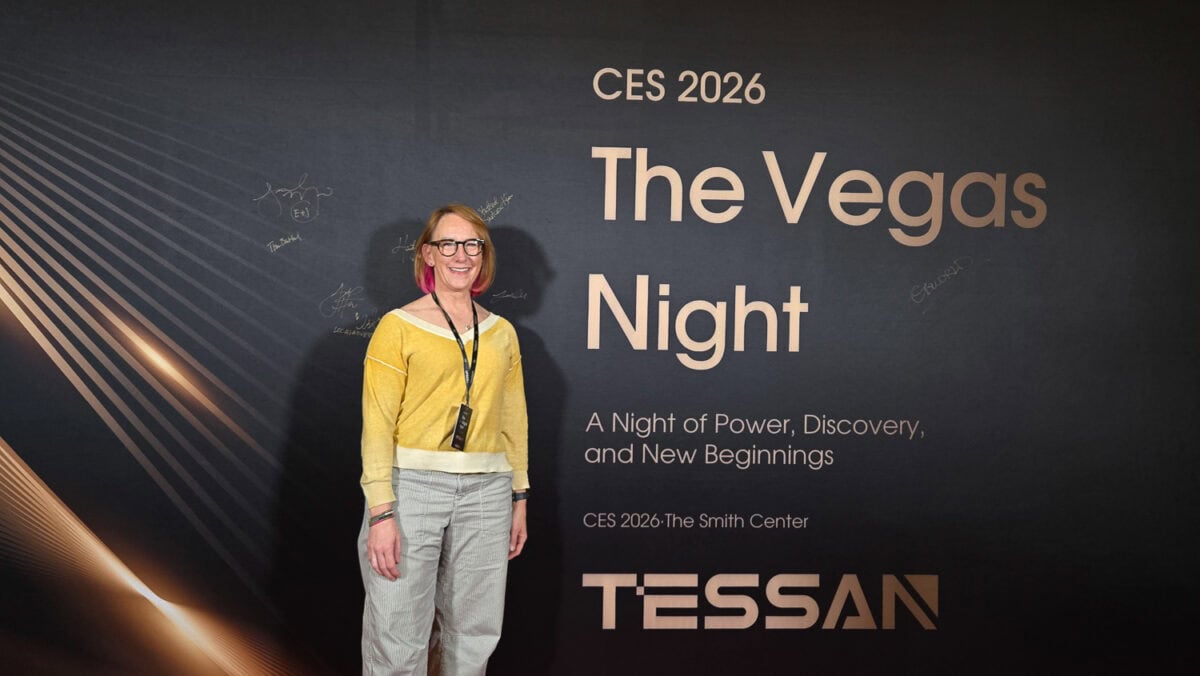
Honestly, the best thing about travel is all of the people you meet. And I’m not just talking about other travelers and the people who live in the places I go – over the years I’ve also had the joy of working with some really cool travel brands, and getting to know the people behind them.
I met TESSAN at the Computer Electronics Show when they were promoting their 100 Travelers campaign. What stood out to me about them was how they focused on the power of travel, and the product came second. Their 100 Travelers campaign was a way to celebrate people’s travel stories all over the world – it was genuine, and I absolutely loved hearing the moving stories of travel. They wanted to inspire more people to travel, which perfectly aligns with my goals for Ottsworld!
“Every journey carries something powerful: A spark of courage. A moment of healing. A longing for connection. These are not just travel stories — they are stories of becoming.”
TESSAN 100 Travelers
Now – a year later – my Capitol to Capitol quest is one of those stories in their campaign! Through all of this – I’ve really gotten to know and love the brand – specifically their powerful and compact travel adapters!
Power Your Journey
When it comes to travel gear, one thing I look for is companies who focus on one thing and they do it well. There are so many gear companies out there that try to be everything – and because of that, I find that their product quality lacks. For example, VIM & VIGR only do compression socks…that’s it – they are experts in compression footwear. Eagle Creek just does suitcases and travel packs. They aren’t also doing coats or shoes…just suitcases.
This is one thing that drew me to TESSAN – they are focused on powering your electronics…that’s it. Because of that – I believe they have some of the best products out there for travel and home office.
Why They Created the Aero 70
TESSAN sent me the story of how the Aero 70 came to be, and I liked reading it because it starts with the same problem I had in India.
Back in 2024 a customer emailed them about a trip through Europe, where the worn-out sockets in a lot of the older hotels couldn’t hold an adapter firmly. Between the loose socket and the weight of the adapter itself, the thing kept slipping out of the wall and landing on the floor. That is the same situation I was dealing with in India with my stack of books.
At the time TESSAN was busy developing a 205W travel adapter, because they assumed what travelers wanted was more power. Then in September 2025 they hosted their annual Castle Night during IFA Berlin and invited journalists, photographers and travel creators from all over the world, and all night long they kept hearing the same thing — nobody wanted more power. People wanted something lighter and safer, and they wanted to be able to see what was happening while their devices were charging. Most of us are charging overnight anyway, and I have eight or ten hours while I’m asleep, so I don’t need my laptop to fill up in twenty minutes.
So they set the 205W project aside and started over, and six months later the Aero 70 was the result. I don’t often get to hear how a piece of gear actually came to exist, and the fact that this one started with travelers telling them what they needed is a big part of why I trust it.
Meet the Aero 70
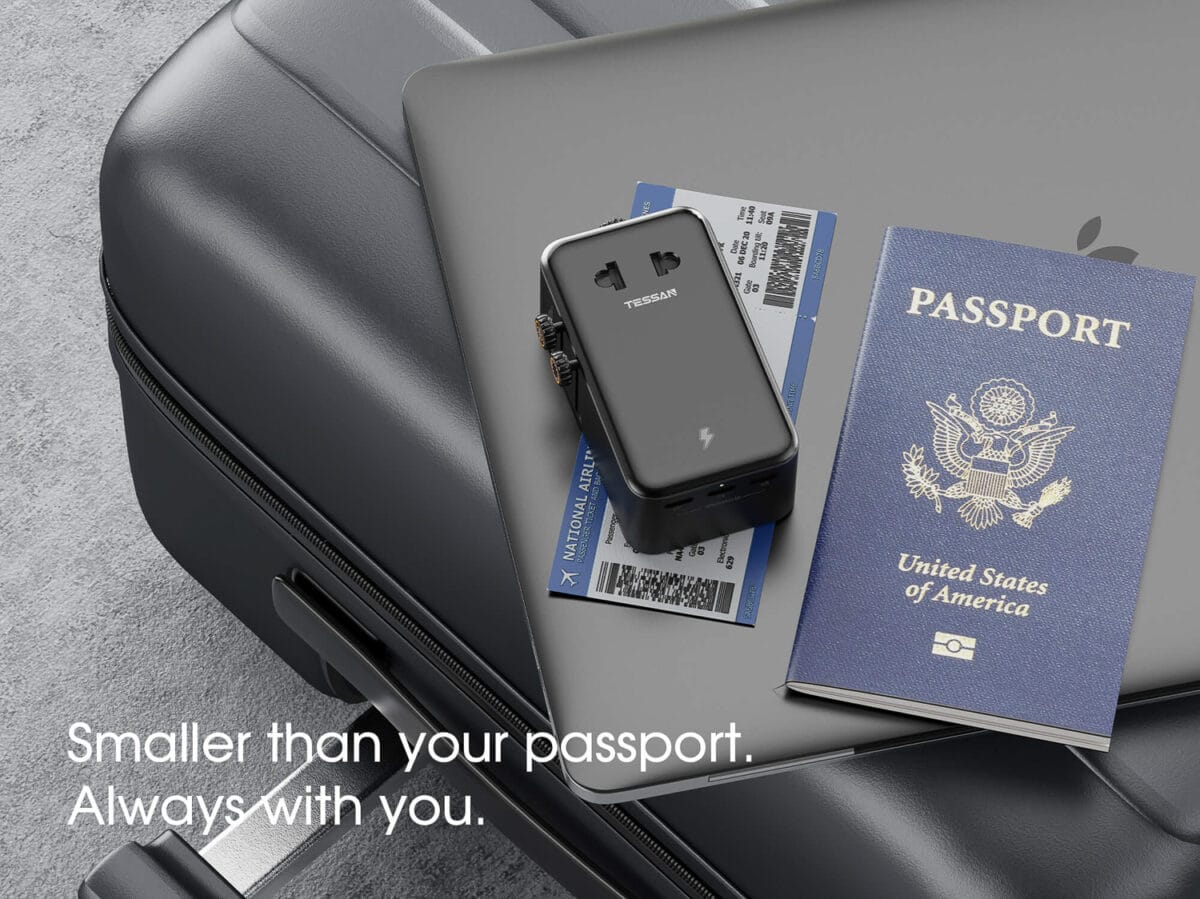
The Aero 70 is a travel adapter with the plugs for the US, UK, EU and AU all built into one unit, 70W of GaN fast charging, a cable built in, and a small display on the front that tells you what’s going on while you charge. It runs $129.
Carry Less
Isn’t that the goal of all travelers?
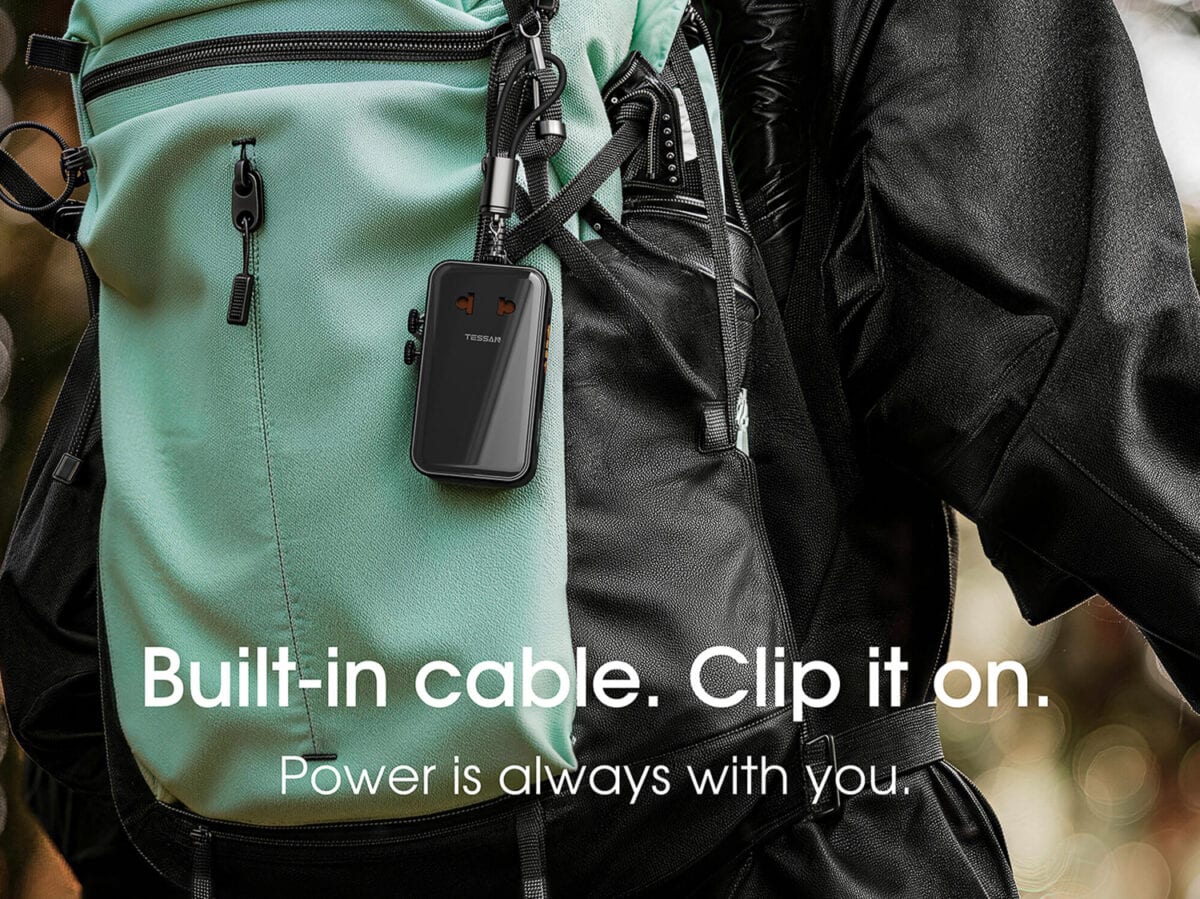
The Aero 70 took the place of three separate things I used to pack – my old plug adapter, my laptop brick, and the little wall charger for my phone. It’s 40% smaller than a standard travel adapter at 3.52 x 1.97 x 1.57 inches, and it weighs 210 grams, so it lies flat in my electronics pouch instead of being the lumpy thing I have to pack around. The cable is built into it too, so that’s one less cord to go hunting for in the bottom of my bag!
It Stays in the Wall
This is the one that matters most to me after India. It’s thin and it’s light, so there’s nothing heavy hanging off the socket pulling it back out, and I haven’t had to build a tower of books under it once.
Charging Five Things at Once
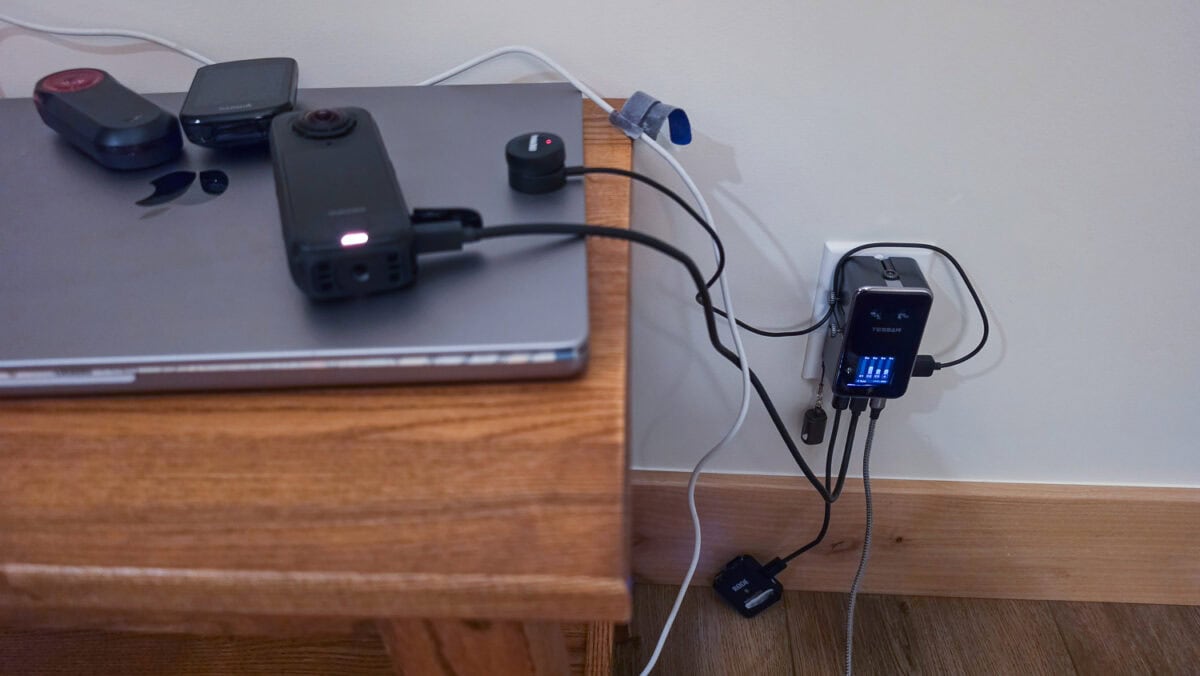
There’s an AC outlet on it plus three USB-C ports and a USB-A port, and you can run all five at the same time. USB-C1 puts out up to 70W, which is plenty for my laptop. C2 and C3 do 20W each for a phone or a tablet, and the USB-A does 18W for older accessories. On a travel night that means my laptop, my phone, my Insta360 and my camera batteries are all charging off the one working outlet in the room – which is the exact hotel room problem I started this post with!
The Display
I’ll be honest, when I first saw that it had a screen on the front I thought it was a gimmick. I use it every time now. It shows the voltage, the wattage, the socket current and the temperature in real time, and it will warn you if it picks up an overload or a temperature it doesn’t like. There’s a built-in fuse as well, plus protection against over-current, over-voltage, short circuits and overheating.
When you’re plugging a laptop into a wall socket in a 100 year old guesthouse in Nepal, being able to look down and see that the numbers are normal is worth a lot. It’s also just useful for knowing whether something is actually charging, which is something I used to have to guess at.
Global Compatibility
The plugs for the US, UK, EU and AU are all built into the one unit, which covers more than 200 countries and territories. I don’t have to think about which adapter goes with which trip anymore, and I don’t have a ziploc bag of loose plug heads rattling around in a drawer. If you travel to a few different regions in a year, that’s the part you’ll notice most!
This is the question I get asked more than any other, so let me cover it plainly. A plug adapter changes the shape of the plug so that it fits the wall. A voltage converter changes the actual voltage coming out of the wall. The Aero 70 is an adapter, and for almost everything you’re packing, an adapter is all you need.
Here’s the part that surprises everybody: your phone, your laptop, your camera battery charger and basically every modern electronic device converts the voltage on its own. They’re built to handle anywhere from 100V to 240V, which is why you can plug your phone into a wall in Nepal or Ireland or Argentina and nothing bad happens. If you want to check, look at the fine print on the charger itself and you’ll see it listed – it will say something like “INPUT: 100-240V.” That means you’re fine anywhere. The Aero 70 handles 100–250V and devices up to 2500W.
The exceptions are single-voltage appliances, and it’s almost always something that makes heat – an old hair dryer, a curling iron, a travel steamer. If the fine print on it only lists 120V, then a plug adapter isn’t going to protect it, and that’s true of every travel adapter on the market and not just this one. Honestly, the easier answer is to leave it at home and use the hair dryer in the hotel!
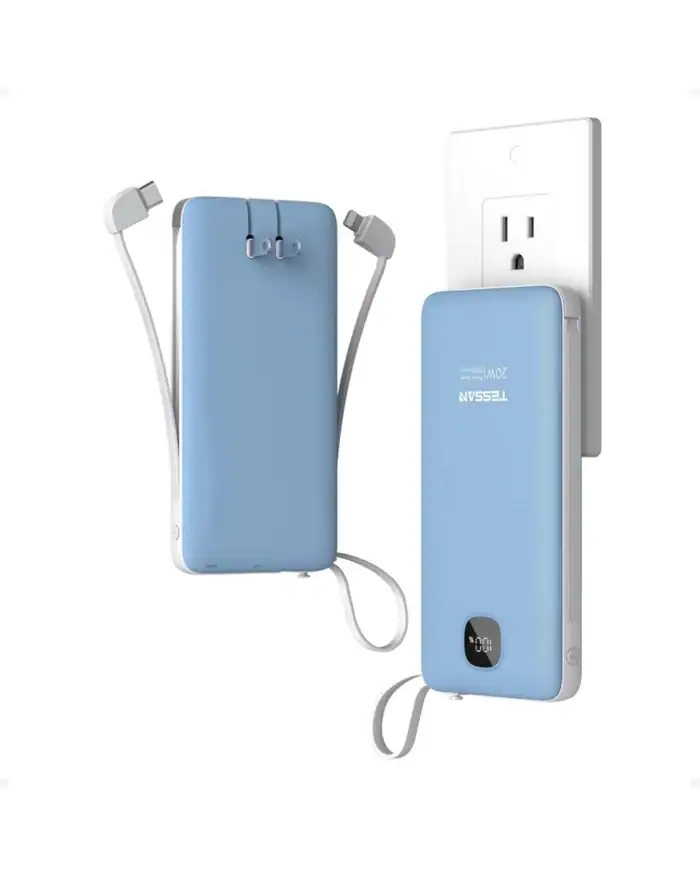
The other TESSAN thing that’s in my bag on every single trip is their 10,000mAh portable charger, and the reason I like this one in particular is that the cables are built right into it. There’s a USB-C, a Lightning and a Micro USB cable attached to the pack itself, plus a USB-A port and a USB-C port, so I’m not carrying a separate handful of cords just in case. It also has a foldable AC wall plug built in, which means it recharges itself by plugging straight into the wall instead of needing yet another cable and brick.
It’s 7.6 oz and 0.67 inches thick, so it slides into a hip pack or a jacket pocket, and it does 20W fast charging. It’s also approved for carry-on luggage, which matters because carry-on is the only place a power bank is allowed to go. It’s $24.99 right now, down from $37.49.
I don’t use this one on the bike rides, but it comes with me on just about every other kind of travel day. When I’m out from morning until dark gathering content, my phone is doing all of the work – photos, video, notes and navigation – and the battery does not survive that. And the last thing I want is to be across Tokyo from my hotel, in the dark, trying to figure out which train I need, with my phone sitting at 4%!
Check out the TESSAN 10,000mAh Portable Charger
I’m home in Denver between trips, and TESSAN is the backbone of my home office setup as much as it is my travel bag – the surge protectors behind my desk and the cat charger sitting on top of it.
The Cat Charger
The TESSAN Cute Cat charging station is a small vertical tower shaped like a cat, and the screen on the front is a cat face that cycles through four different expressions while it’s charging. It puts out 65W across four ports, two USB-C and two USB-A, so my phone, my iPad and my headphones all live on it. It stands upright so it takes up almost no room on my desk, the base is anti-slip so it works lying down too, and it came with cable ties, which I needed more than I’d like to admit. It has the same safety setup as the Aero 70 – over-voltage, over-current, overheating and short circuit protection, plus surge protection and real-time temperature monitoring.
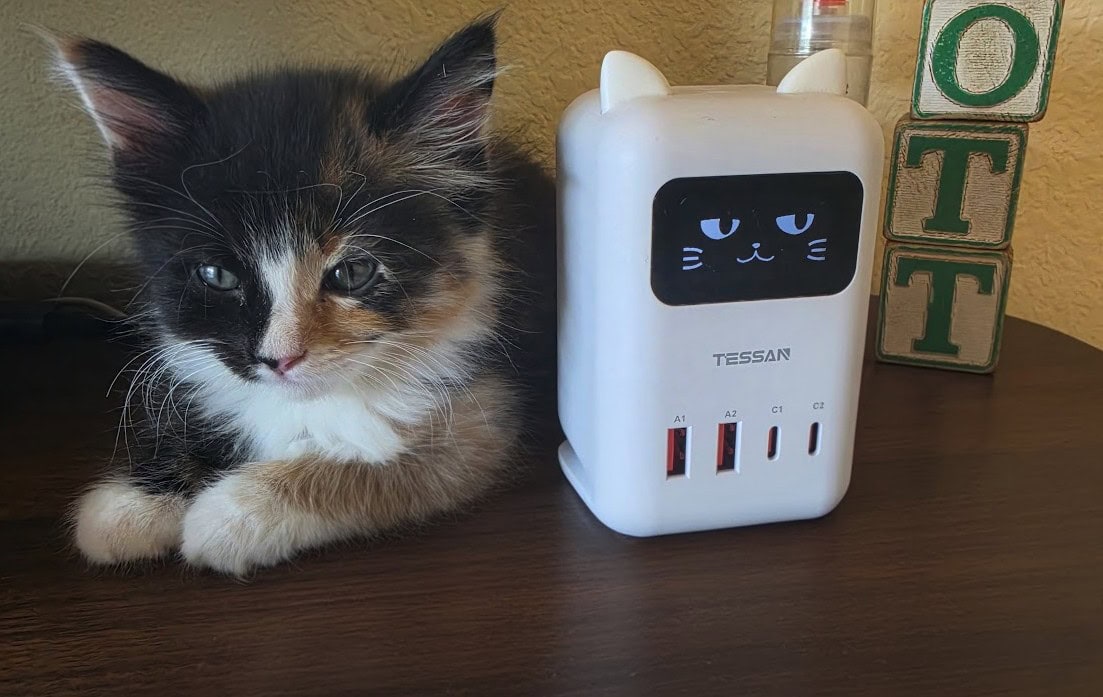
I foster kittens, so there are usually a couple of real ones in my office too!
Check out the TESSAN Cute Cat Charging Station
The Surge Protectors
Everything in my office runs through TESSAN surge protectors – the monitors, the laptop, the camera gear and the lights. I’m using their new Smart Surge Protector Pro, which isn’t up on their site yet because it’s so new, so in the meantime their surge protector power strip is the one I’d point you to.
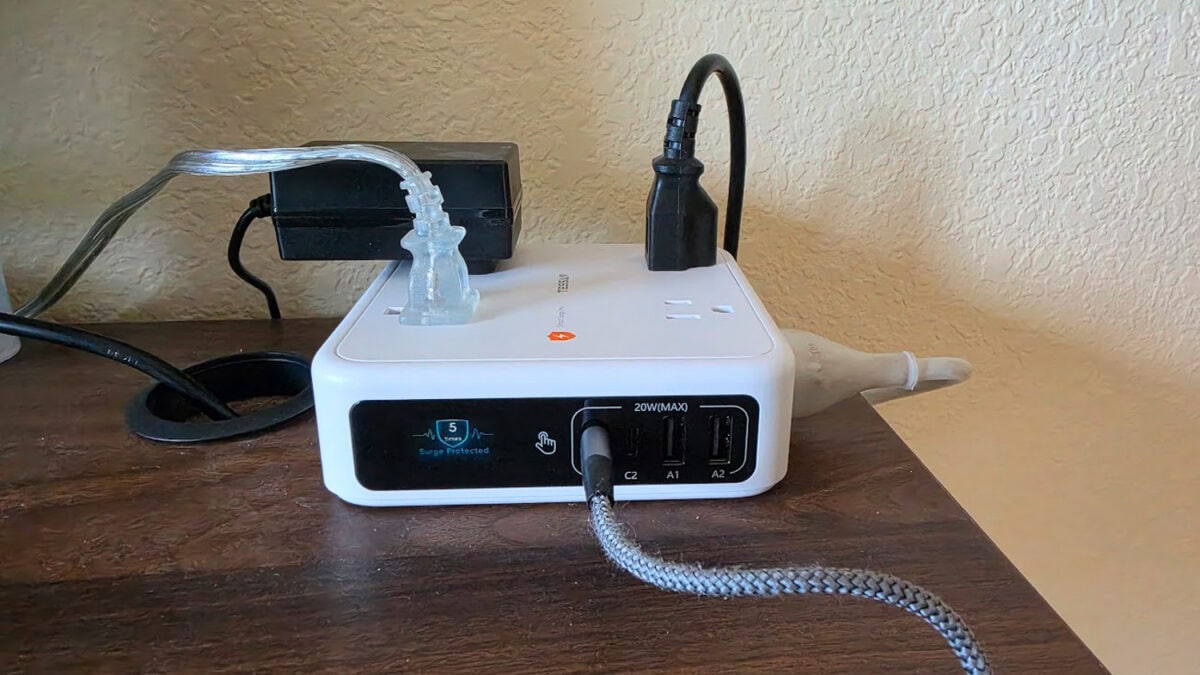
That one gives you 8 AC outlets spaced far enough apart that one fat plug doesn’t block the outlet next to it, plus three USB ports including a USB-C, 900 joules of surge protection, and a built-in circuit breaker. It has a flat plug with a low profile head, so it sits almost flush against the wall instead of sticking out behind the desk, and there are keyholes on the back if you’d rather mount it. It’s $27.99.
I spent 11 years living out of a suitcase, so I don’t own a lot of stuff, but what I do own is what I make my living with – and a surge protector is a cheap thing that protects expensive things!
Check out the TESSAN Surge Protector Power Strip
TESSAN Discount Code
TESSAN has graciously given me a promo code for anything on their site! Get 5% off your order when you use promo code SHERRY
I started this post with the moment I realized the world didn’t revolve around the United States, and that different outlets and different voltage were a part of that. It sounds like such a small thing now, but standing in a room in another country looking at a wall socket I didn’t recognize was one of the first times it truly landed that I was somewhere else – and that there were a lot of ways of doing things that nobody had ever shown me.
Twenty years later I’m still plugging into strange walls. The gear has gotten a lot easier, and it’s one small piece of equipment now instead of a stack of books, but the reason I’m standing in those rooms hasn’t changed at all. TESSAN called the stories in their campaign “stories of becoming,” and I think that’s exactly right. Mine started with a passport at 30 and a whole lot of things I didn’t understand yet, the outlets included, and it’s still going!
So what’s the worst outlet situation you’ve ever dealt with? Mine is still that hotel room in India with the stack of books holding the adapter up against the wall, and I’d love to hear yours in the comments!
Frequent Questions I Get Asked
Do I need a voltage converter, or just a plug adapter?
For almost everything you’re packing, a plug adapter is all you need. A plug adapter changes the shape of the plug so that it fits the wall, while a voltage converter changes the actual voltage coming out of it – and your phone, your laptop, your tablet and your camera battery charger all convert voltage on their own. If you want to check, look at the fine print on the charger itself and you’ll see something like “INPUT: 100-240V,” which means it works anywhere in the world. The Aero 70 is an adapter, and it handles 100–250V and devices up to 2500W.
Can I use a hair dryer or a curling iron with the Aero 70?
No, and this is the one real exception to the answer above. Hair dryers, curling irons and travel steamers are often single-voltage, so if the fine print on yours only lists 120V, then no plug adapter is going to protect it – not the Aero 70 and not any other one on the market. The easier answer is to leave it at home and use the hair dryer in your hotel, which is what I do.
Will the Aero 70 work in Japan, the UK, Europe and Australia?
Yes, all four, and more than 200 countries and territories in total. The plugs for the US, UK, EU and AU are all built into the one unit – Japan uses the same Type A plug as the US, the UK has its own Type G, most of Europe is Type C, and Australia is Type I. You don’t need to buy anything extra or remember which plug head goes with which trip!
Is the Aero 70 a surge protector?
No, and it’s worth being clear about that. It has a built-in fuse plus protection against over-current, over-voltage, short circuits and overheating, which covers the things that tend to go wrong in an unfamiliar hotel socket. But it isn’t a joule-rated surge protector like the power strips I use at home, so it isn’t what you’d rely on to protect expensive equipment from a lightning strike or a big spike.
Is the Aero 70 worth $129 when a basic plug adapter costs $20?
That depends on how much you’re charging and how often you travel. A $20 adapter changes the plug shape and nothing else, so you still pack your laptop brick and your phone charger on top of it, and you still have the one-outlet problem when you get to the room. The Aero 70 replaced numerous things in my tech pouch and charges five at once, and that’s what I’m paying for. If you take one trip a year and you travel with a phone and not much else, a cheap adapter is genuinely fine and I’d tell you to buy that instead!
Can I bring the TESSAN power bank on a plane?
Yes, but it has to go in your carry-on. Power banks are banned from checked luggage, so it comes in the cabin with you – and if your carry-on gets gate-checked at the door, take the power bank out first. Keep in mind – international rules now limit you to two power banks per passenger, and you’re no longer allowed to recharge a power bank during the flight, so don’t plug it into the seat-back USB port. Individual airlines can be stricter than that too – Southwest now allows just one.